Archiving and retention strategies for Law No. 5651 projects are not just about keeping log files on a large disk. A defensible model combines which traffic data is generated for which role, how long records are retained, how integrity is protected, who can access the archive, and what happens when the retention period ends.
This guide is written for IT, security, and compliance teams designing log collection, archiving, SIEM, and audit evidence for Law No. 5651 compliance. Legal interpretation should be reviewed against the organization's own operating model; the focus here is the technical and operational control framework.
Quick Summary
- The first step in a Law No. 5651 archiving strategy is role analysis: hosting providers, access providers, and collective-use providers do not have the same retention model.
- Traffic data should be treated as a chain of records that may include IP address, port, timestamp, service type, data volume, and subscriber or user relationship where available.
- For hosting providers, traffic data retention commonly maps to a
1 yearto2 yearframe; for access providers, the frame is commonly6 monthsto2 years. - Archiving is not only retention duration; NTP, hashing, signing, immutable storage, access logs, and restore tests should be designed together.
- Law No. 5651 logs often intersect with personal data under KVKK, so retention period, access rights, and disposal plans should be documented separately.
- A strong audit package includes source inventory, retention matrix, sample log output, integrity proof, permission list, and a tested search procedure.
Table of Contents
- Why Should Law No. 5651 Archiving Be Designed Separately?
- Which Logs Fall Within Retention Scope?
- How Should a Retention Matrix Be Built?
- How Is Archive Integrity and Evidence Value Protected?
- How Should SIEM, Syslog, and Cold Archive Be Separated?
- How Should KVKK Retention and Disposal Be Balanced?
- 90-Day Implementation Plan
- Related Content
- Next Step with Leon-X
- Frequently Asked Questions
- Sources
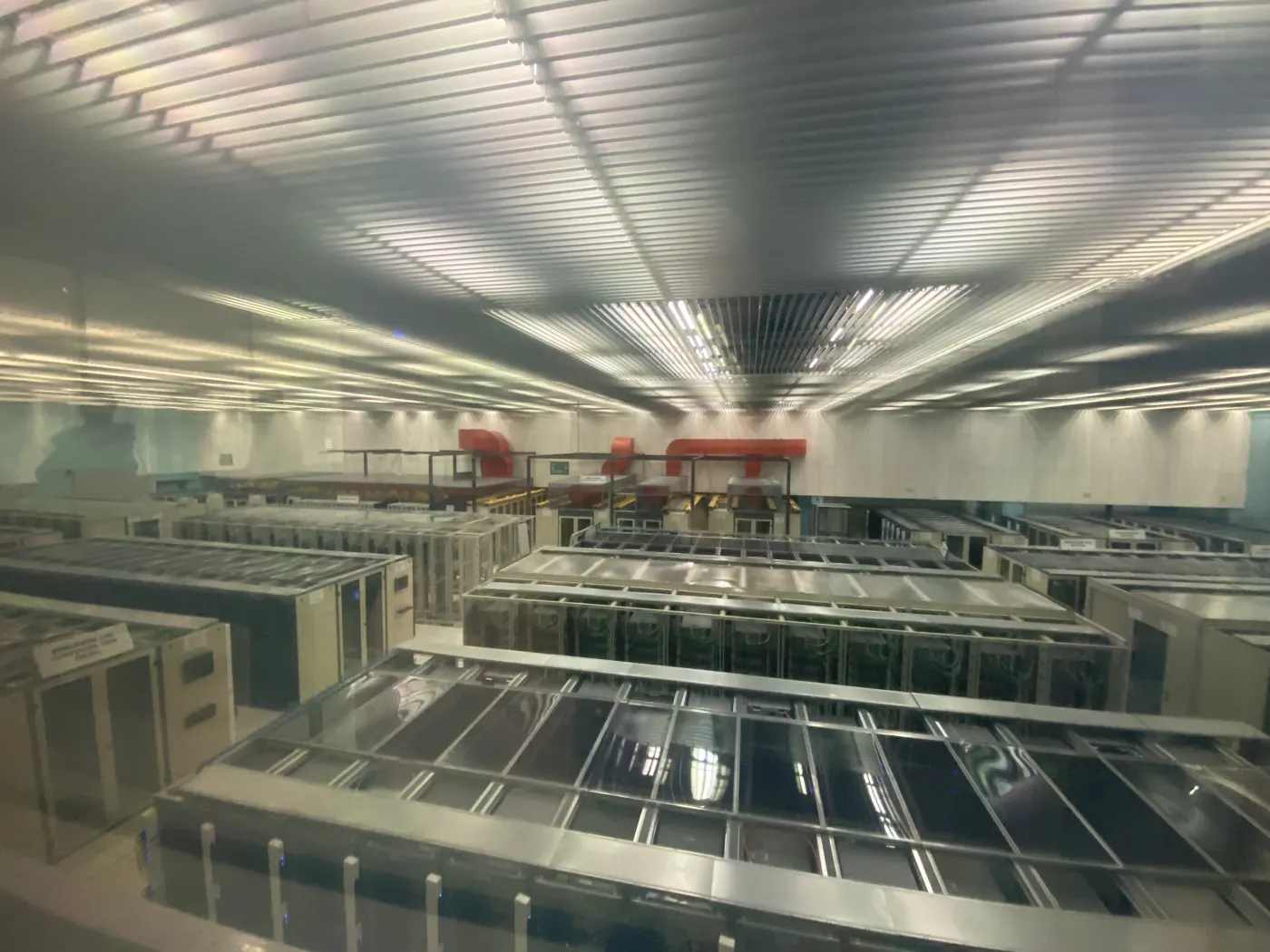
Image: Wikimedia Commons - Data storage Centre, CERN. Optimized as WebP.
Why Should Law No. 5651 Archiving Be Designed Separately?
The common mistake in Law No. 5651 projects is treating “logs are going to SIEM” as an archiving strategy. SIEM provides visibility; archiving keeps records discoverable, integrity-protected, and audit-ready throughout the required retention period. Both goals may use the same platform, but they are not the same control.
Archiving should be designed separately because:
- as the number of log sources grows, the risk of incomplete records grows
- SIEM indexing duration may not match legal retention duration
- raw logs, normalized events, and report outputs have different evidence value
- unauthorized log searches may create KVKK and internal security risk
- personal data retained after its purpose expires may create a separate compliance issue
At the start of a Law No. 5651 project, three questions should be documented:
- which record is retained for which role?
- in which system is the record retained and for how long?
- how is the record found when needed and how is its integrity proven?
Which Logs Fall Within Retention Scope?
Traffic data under Law No. 5651 should not be reduced to a simple log file generated by one device. The traffic-data concept focuses on making the access event visible through identity, address, port, time, and service relationship. The scope changes according to the organization's role.
Typical sources include:
| Source | Retention purpose | Control point |
|---|---|---|
| firewall and NAT logs | showing the relationship between internal user and external destination | source IP, destination IP, port, time, and action |
| DHCP records | showing which device received an internal IP address | lease start/end time and MAC address |
| proxy and web gateway | centralizing the web access trace | URL, category, user, time |
| hotspot or guest Wi-Fi | user identification and session record | authentication method, session, and IP relationship |
| hosting panel and web server | mapping hosted service to customer relationship | domain, customer, IP, access log |
| DNS, VPN, and load balancer | completing the intermediate layers in the access chain | query, session, virtual IP, and backend relationship |
| SIEM or log management | providing correlation and search capability | source health, index, alerting, and integrity |
Without source inventory, retention strategy remains incomplete. For example, if an organization retains only firewall logs but lacks DHCP or authentication records, it may be unable to map the internal IP address at incident time to a real user or device. The reverse can also happen: user identity exists, but the external access chain is broken because NAT port records are missing.
How Should a Retention Matrix Be Built?
A retention matrix shows the role, data type, required duration, operational need, and disposal method for each log source. It should be the single reference for both IT operations and compliance review.
Example matrix:
| Data set | Law No. 5651 role relationship | Recommended operational layer | Minimum design question |
|---|---|---|---|
| hosting-provider traffic data | hosting and colocation services | central log management + archive | can customer, domain, and IP relationship be reconstructed? |
| access-provider traffic data | structures providing internet access | firewall/NAT + SIEM + archive | does source user map to external destination? |
| collective-use access record | guest Wi-Fi, shared internet areas | hotspot/NAC + syslog + archive | are user identification and session duration preserved? |
| security alert | incident review and correlation | SIEM index | can the alert be tied back to raw records? |
| audit report | governance and evidence package | document management | can the report be traced back to the raw data used to produce it? |
At this layer, SIEM and Security Event Management Integration under Hardware and Software Solutions standardizes not only collection, but also retention, correlation, and audit output. On the governance side, the Cybersecurity Assessment Service under Business Management Services identifies which records are missing or retained unnecessarily.
How Is Archive Integrity and Evidence Value Protected?
In a Law No. 5651 project, the value of an archived log depends not only on its existence, but also on proving that it has not changed. If a log file can be deleted, modified, or accessed without traceability, it remains weak during audit or incident review.
Minimum integrity controls:
- central NTP standard for all log sources
- secure transport between source devices and collectors
- daily or hourly hash generation
- signed archive packages or WORM/immutable storage
- separate permission group for archive access
- logging of users who search logs
- regular restore and search tests
- alerts when a source stops sending logs
The goal is not to claim that nobody can ever touch a log. The goal is that authorized activity leaves a trace and unauthorized modification is detectable. In high-volume environments, hash chains, immutable buckets, secondary archive copies, and audit access logs should be used together.
How Should SIEM, Syslog, and Cold Archive Be Separated?
A healthy Law No. 5651 architecture separates three layers.
1. Collection layer
Syslog collectors, agents, API connectors, or log forwarders live here. Their job is to receive raw data from sources, preserve timestamps, and monitor loss. Source health is the critical metric in this layer: how many sources are sending data, which source stopped, and how many minutes of delay exist?
2. Operational analysis layer
SIEM operates in this layer. Normalization, correlation, alerting, and incident review happen here. SIEM index duration is often limited because of cost and performance. For that reason, an organization may keep 90 days of hot SIEM search while retaining raw archives for 1 year or longer.
3. Cold archive layer
Cold archive is for records that are rarely searched but must be retrievable when needed. Object storage, immutable buckets, offline backups, encrypted archive zones, or WORM-capable systems can be used here. The critical point is that cold archive should be designed with a retrieval procedure, not only with storage capacity.
Practical targets:
- fast SIEM search for the last
90 days - raw log archive for the legal retention period
- monthly integrity check
- restore test every three months
- at least one audit-package production test per year
How Should KVKK Retention and Disposal Be Balanced?
Law No. 5651 records often intersect with personal data. Records combined with IP address, username, phone verification, MAC address, customer number, support request, or subscription information should also be protected under KVKK.
The retention policy should separate:
- records required or needed for Law No. 5651
- additional event data retained for security operations
- records retained for customer support or business continuity
- data sets that are no longer needed and should be disposed of
From a KVKK perspective, the stronger model is not “keep as much as possible.” Records should be retained for the duration connected to law and purpose; when that duration ends, deletion, destruction, or anonymization should be executed. The Personal Data Retention and Disposal Policy should not conflict with the Law No. 5651 retention matrix.
This topic should be read with What Is the Difference Between Law No. 5651 and KVKK?. Getting that separation right clarifies which record is retained for a legal obligation and which one is retained for security operations.
90-Day Implementation Plan
Days 1-15: Role and source inventory
- clarify the organization's Law No. 5651 role with legal and IT teams
- list firewall, DHCP, VPN, DNS, hotspot, proxy, hosting panel, and server log sources
- document owner, format, time standard, and data volume for each source
- separate missing sources into risk acceptance or project work items
Days 16-35: Retention and access matrix
- define retention period, access group, and disposal method for every data set
- separate SIEM hot-index duration from cold-archive duration
- bind log search and export permissions to a separate role
- document encryption and backup standards for archive copies
Days 36-60: Integrity and search test
- check NTP drift
- generate hash or signature for sample log packages
- define source-based alerting and data-loss rules in SIEM
- run a sample restore test from cold archive
Days 61-90: Audit package
- combine role analysis, source inventory, and retention matrix into one package
- produce a sample incident output showing user, IP, port, time, and source chain
- add archive access logs and integrity verification results
- map nonconformities to corrective action plans
Related Content
- What Are Law No. 5651 Obligations for Hosting Companies?
- What Is the Difference Between Law No. 5651 and KVKK?
- KVKK Requirements for Dell Server Logging
- How to Configure VMware Logging for KVKK
Checklist
- Law No. 5651 role analysis was documented
- all sources generating traffic data were listed
- retention-period matrix was created
- SIEM hot index and cold archive durations were separated
- NTP, hash, signing, or immutable retention controls were defined
- archive access rights were separated
- KVKK retention and disposal policy conflict was checked
- restore and audit-package tests were completed
Next Step with Leon-X
Archiving and retention strategy in Law No. 5651 projects requires logs to become an audit-ready, searchable, and integrity-protected evidence set, not just collected events. Leon-X clarifies role, process, and control gaps through Business Management Services and the Cybersecurity Assessment Service. On the technical side, Hardware and Software Solutions and SIEM and Security Event Management Integration connect log collection, correlation, archive, and audit architecture to a corporate standard. To assess your current logging infrastructure or request a proposal, continue through the Contact page.
Related pages:
- Business Management Services
- Cybersecurity Assessment Service
- Hardware and Software Solutions
- SIEM and Security Event Management Integration
- Contact
Frequently Asked Questions
Is keeping Law No. 5651 logs in SIEM enough?
Not by itself. SIEM provides operational analysis; legal retention, integrity, access logging, and cold-archive procedure should be designed separately.
Is the Law No. 5651 archiving period the same for every organization?
No. Retention duration should be assessed according to the organization's Law No. 5651 role, data type, and applicable legal frame.
Are hash or signature controls mandatory for log archives?
They should not be treated as the same technical requirement for every scenario, but hashing, signing, immutable storage, or equivalent controls are strong practices for proving integrity.
Do Law No. 5651 logs fall under KVKK?
Records that can be linked to IP, user, customer, MAC address, or session information may have a personal-data dimension. Access and disposal controls should therefore be handled together with KVKK.
How often should cold-archive restore tests be run?
For critical environments, a sample restore test every three months is a practical starting point. Higher-risk environments may prefer monthly checks or automated integrity validation.
Conclusion
Archiving and retention strategies for Law No. 5651 projects are not about accumulating logs somewhere. The stronger model manages role analysis, source inventory, retention matrix, integrity control, SIEM search, cold archive, and KVKK-aligned disposal in one design. That structure helps incident review move faster and produces more defensible audit evidence.