When people ask what Dell PowerScale is, the question is often framed too narrowly as “is it just another NAS box?” The short answer is broader than that. In the March 20, 2026 context, Dell PowerScale is a scale-out NAS storage architecture platform built on OneFS, designed to run as a distributed cluster with a single namespace for enterprise file workloads. This guide explains the architectural traits that separate PowerScale from a more traditional NAS approach.
This guide is especially useful for:
- enterprise storage architects
- IT teams planning a NAS modernization project
- organizations managing fast-growing file and archive workloads
- teams evaluating media, analytics, AI data pools, or multiprotocol file access
Quick Summary
- Dell PowerScale should be evaluated as a clustered NAS architecture, not as a single appliance.
- OneFS runs the cluster as one file system and one namespace across nodes.
- Clients can connect to any node in the cluster instead of relying on a single volume-bound access model.
- The core architectural value is reducing the operational burden that usually comes with fragmented namespace and volume management.
- PowerScale becomes especially relevant for large-scale file growth, high-throughput access, and multi-client unstructured data environments.
- The most common mistake is treating PowerScale as only “a larger file server” instead of an enterprise-scale NAS architecture.
Table of Contents
- What Exactly Is Dell PowerScale?
- What Makes PowerScale Different from Traditional NAS?
- Why Does the OneFS Single-Namespace Model Matter?
- Which Workloads Fit PowerScale Best?
- Common Design Mistakes
- Architecture and Buying Checklist
- Frequently Asked Questions
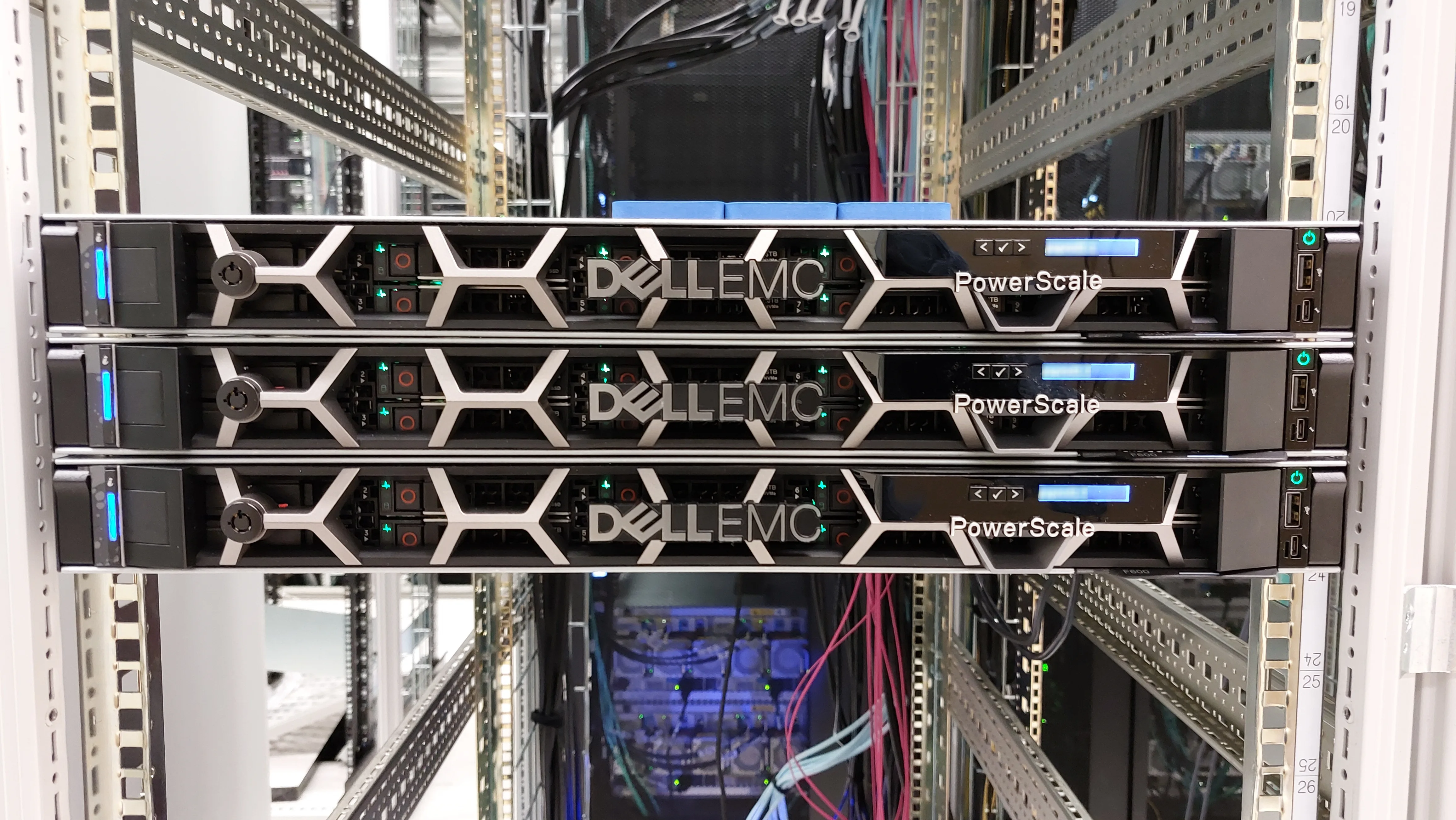
Image: Wikimedia Commons - Dell PowerScale F600 nodes in storage cluster.
What Exactly Is Dell PowerScale?
Dell PowerScale is Dell’s scale-out NAS family for enterprise-grade file growth and large unstructured-data environments. In Dell’s official positioning, PowerScale is presented as a platform built for modern high-scale data environments and demanding throughput-driven workloads.
The key point is that PowerScale should not be treated like an isolated NAS appliance. Its real value comes from the clustered architecture that allows organizations to expand capacity and access behavior together through nodes rather than through a fragmented volume-by-volume model.
That means the better answer to “what is Dell PowerScale?” is:
- a distributed enterprise NAS platform
- a OneFS-based storage architecture with a single namespace
- a file-centric storage layer designed for scale, growth, and operational simplicity
What Makes PowerScale Different from Traditional NAS?
Traditional NAS environments often run into the same growth issues:
- separate volume planning
- namespace fragmentation
- manual file movement and balancing work
- capacity growth that does not cleanly align with operational simplicity
Dell’s OneFS technical documentation explicitly states that each cluster creates a single namespace and file system, and that clients can access data through any node in the cluster. That is a different operational model from more conventional volume-driven NAS design.
In practical terms:
- traditional NAS often grows in separate chunks
- PowerScale aims for a more centralized single-tree operating model
- many conventional NAS environments accumulate administrative overhead as they scale
- PowerScale hides more of that complexity inside the file system architecture itself
Why Does the OneFS Single-Namespace Model Matter?
OneFS is the architectural core of PowerScale. According to Dell’s technical overview, each cluster operates with:
- one namespace
- one file system
- distributed access across all cluster nodes
That matters for several reasons.
1. It reduces volume complexity
As environments grow, conventional systems often create additional volumes, shares, or namespace layers. The OneFS model reduces how visible and disruptive that complexity becomes.
2. Access is not tied to one node
Clients can connect to any node in the cluster. Because data and metadata are distributed, the access model is not built around a single isolated gateway concept.
3. There is no separate metadata-server dependency
Dell’s technical documentation specifically notes that the architecture does not depend on a single metadata server, lock manager, or gateway node. That is a meaningful architectural difference for resilience and simplicity.
4. It better supports multiprotocol file access
Dell’s OneFS material shows a single file system serving multiple access methods within the same architectural frame. That makes PowerScale a stronger fit for organizations with mixed file-access patterns.
Which Workloads Fit PowerScale Best?
PowerScale is not the default answer to every storage problem. It makes the most sense in scenarios such as:
- large-scale enterprise file sharing
- media and content production repositories
- analytics and data-lake-style unstructured-data environments
- AI data pipelines that depend on high-throughput file access
- NAS architectures expected to grow significantly over time
It becomes especially compelling when file-based growth, client concurrency, and namespace management would otherwise become operational bottlenecks.
Related content:
- Dell Storage Disk Types and Performance Comparison
- What Is a VMware NFS Datastore?
- VMware Storage Architecture Best Practices
Common Design Mistakes
Treating PowerScale as only a capacity-expansion product
The real value is not only raw capacity. It is the namespace model, distributed file system design, and operational behavior.
Evaluating file workloads with a block-storage mindset
PowerScale is strongest when the problem is fundamentally file-centric. Treating it like a direct replacement for every block-storage scenario leads to poor architectural decisions.
Skipping protocol and client-behavior analysis
NFS, SMB, or mixed access patterns should be evaluated together with throughput, metadata intensity, and growth behavior.
Planning only for day-one size
Scale-out NAS design should account for front-end networking, growth stages, and node expansion from the start.
Architecture and Buying Checklist
- File-based workloads were separated from block and backup use cases
- Namespace growth and user/share expansion were projected over multiple years
- NFS, SMB, or mixed-access patterns were defined early
- Front-end network design and node-growth planning were reviewed together
- Metadata behavior and throughput targets were measured alongside capacity
- The difference between PowerScale and other NAS or general storage options was clearly documented
Next Step with Leon-X
When planned correctly, a PowerScale project is not just a NAS purchase. It is a redesign of how the organization handles file access, growth, and long-term operations. Leon-X helps teams position PowerScale correctly by aligning workload profile, network design, node-growth planning, and the target operating model.
Related pages:
Frequently Asked Questions
Is Dell PowerScale a NAS platform?
Yes, but it should be understood as a scale-out NAS architecture rather than a basic standalone NAS device.
Why is OneFS so important?
Because the main operational difference comes from OneFS running the environment as one distributed file system with one namespace.
What types of data fit PowerScale best?
It is best suited to file-based, fast-growing, high-concurrency unstructured-data environments.
Does PowerScale replace block storage?
Not in every case. Its strength is enterprise-scale file access and NAS architecture, not every possible block-storage requirement.
Why is PowerScale considered more scalable than traditional NAS?
Because the clustered model, single namespace, and distributed file system architecture help keep growth more manageable operationally.
Conclusion
The right answer to “what is Dell PowerScale?” is not “a bigger NAS box.” As of March 20, 2026, PowerScale is a NAS storage architecture platform built around OneFS, a single namespace, and a distributed cluster-wide file system model. That is what moves it beyond the limits of a conventional NAS approach: it brings capacity growth, access behavior, and operational simplicity into a more unified architecture.