Dell Storage high availability is not just about adding a second controller or saying that failover exists. In practice, the availability model depends on controller redundancy, node or appliance clustering, host-path resilience, data placement, and sometimes site-level protection. The short answer is this: in the March 26, 2026 context, Dell Storage high availability is an architectural model rather than a single feature, and PowerStore cluster high availability, Metro Volume, and PowerScale cluster behavior are some of the clearest examples of how it works. This guide is written for teams that want to understand Dell storage HA at an architectural level instead of as a checkbox.
This guide is especially useful for:
- storage and virtualization administrators
- IT leaders planning new NAS or SAN architecture
- architects who want to understand failover behavior together with sizing
- organizations trying to separate device-level redundancy from site-level continuity
Quick Summary
- High availability is not just controller redundancy. It is the combination of device, path, cluster, and site behavior.
- On PowerStore, cluster high availability depends on appliance-level service continuity and quorum logic.
- Metro Volume can provide an active-active style model across two sites when the topology fits.
- On PowerScale, OneFS uses a node-based cluster model with a single namespace.
- Host-side path redundancy and multipathing are also critical parts of storage HA.
- The most common mistake is treating HA, replication, and backup as if they were interchangeable.
Table of Contents
- What Does Dell Storage High Availability Actually Mean?
- Is Controller Redundancy Alone Enough?
- How Does High Availability Work on PowerStore?
- How Does High Availability Work on PowerScale?
- When Is Site-Level Resilience Necessary?
- What HA Design Mistakes Happen Most Often?
- Checklist
- Frequently Asked Questions
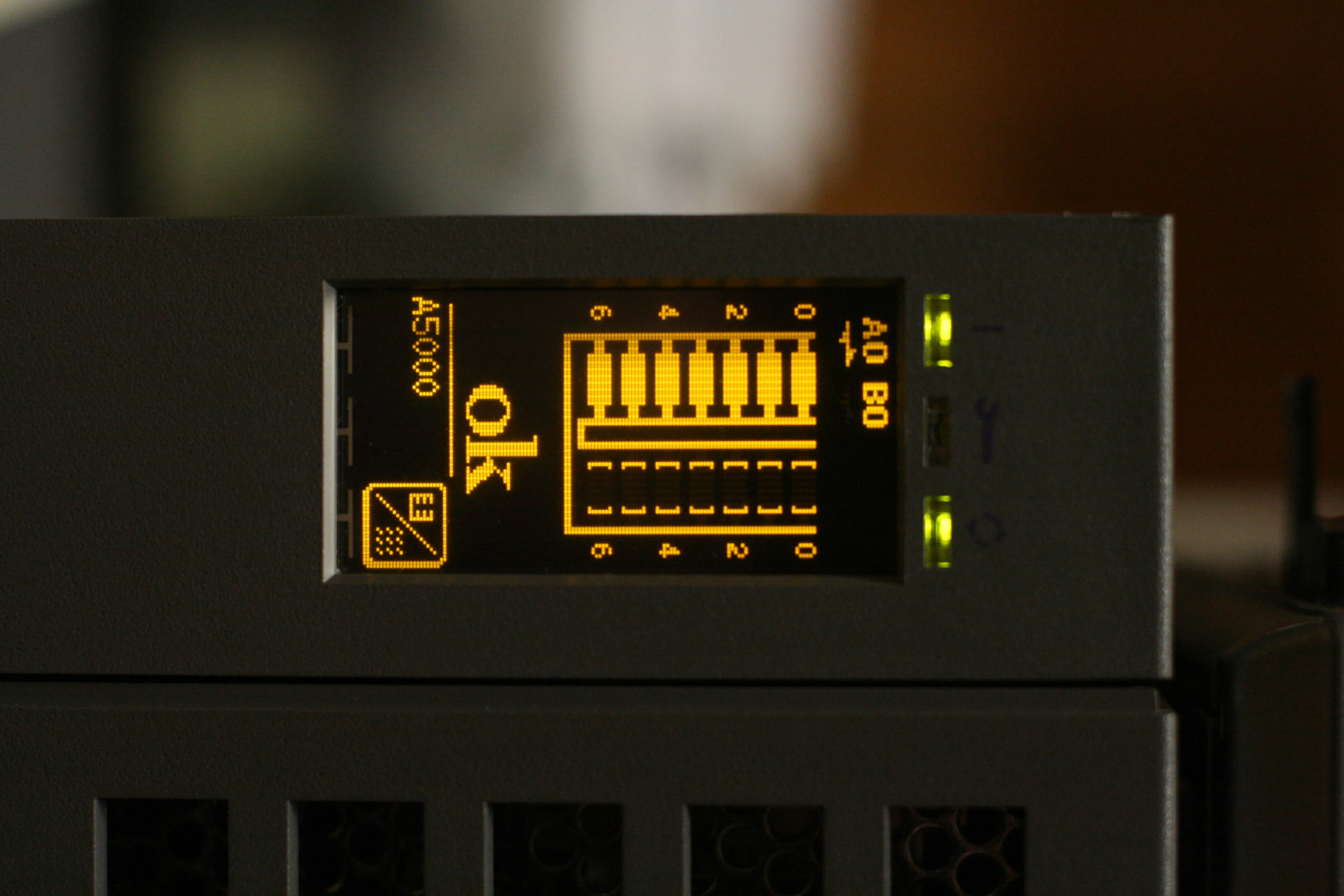
Image: Wikimedia Commons - Sun A5000 Storage Array Display.
What Does Dell Storage High Availability Actually Mean?
Dell Storage high availability is about answering one core question: when one part fails, how does data service stay available?
That question should be handled across at least four layers:
- controller or node layer
- disk and data-protection layer
- host connectivity and multipath layer
- site-level or metro layer when required
So HA is a behavior model, not a single feature. Internal redundancy inside the storage array is important, but it is not enough on its own without path, topology, and operational design.
Is Controller Redundancy Alone Enough?
No. Controller redundancy matters, but it is not the whole story. Availability is also shaped by questions like:
- how many independent host paths exist?
- is there a single point of failure in the switching layer?
- is the data protected only inside one appliance or also across sites?
- what happens to performance after failover?
That is why “we bought a dual-controller storage system” is not the same as having a complete HA design.
How Does High Availability Work on PowerStore?
Dell PowerStore documentation explicitly describes a two-node appliance model and cluster high-availability behavior.
1. Appliance-level node resilience
Each PowerStore base enclosure contains two nodes. If one node is lost, the system is designed to preserve service continuity within the appliance. But the design should be read in terms of services, quorum, and ownership behavior, not just node count.
2. Cluster high availability
Dell’s cluster high-availability guidance shows that multiple appliances can operate inside one cluster. That increases aggregate resources and operating flexibility. It does not mean every volume is simultaneously served by every appliance at all times.
3. Quorum behavior
Management-plane continuity depends on communication integrity inside the cluster. That makes N/2+1 quorum logic and cluster-service behavior an invisible but critical part of HA. If the network design is weak, the storage platform cannot deliver the expected availability outcome.
4. Metro Volume for site-level active-active design
Dell’s Metro Volume architecture can provide an active-active style access model across two sites when the topology supports it. That goes beyond appliance-level redundancy. But Metro Volume is not a default requirement for every organization. It only makes sense when latency, network design, and operations are mature enough.
How Does High Availability Work on PowerScale?
On PowerScale, high availability should be read through the OneFS clustered file-system model.
1. Node-based scale-out cluster
PowerScale runs on a clustered node model rather than on a single isolated storage head. That changes how resilience and growth are handled.
2. Single namespace advantage
The single namespace model makes client access behavior look more unified. That simplifies both failover operations and long-term scaling.
3. File-service continuity
It is a mistake to think of PowerScale only as capacity expansion. OneFS distributes file-system behavior across the cluster, so availability is built into the service model itself.
4. Workload fit still matters
PowerScale is strong for high-throughput and large unstructured-data environments, but it is not a direct substitute for every block-storage use case. Wrong platform placement weakens the practical value of HA even if the product itself is resilient.
When Is Site-Level Resilience Necessary?
Same-site HA and site-level continuity are not the same thing.
Site-level design becomes more important when:
- production data must survive a full site issue
- the risk model includes not only device loss but also location loss
- the application requires low RTO and low RPO
- continuity evidence is expected for audit or contractual reasons
At this point, replication, Metro Volume, and backup need to be treated as separate layers. HA helps preserve service continuity. Backup helps recover data. They do not replace each other.
Related Content
- What Is Dell PowerStore Controller Architecture?
- Dell Storage Backup Requirements for KVKK
- What Is Dell PowerScale? NAS Storage Architecture
What HA Design Mistakes Happen Most Often?
Treating HA as the same thing as backup
High availability is for service continuity. Backup is for data recovery.
Looking only at controller count
If path redundancy, quorum, cluster behavior, and site design are ignored, the architecture remains incomplete.
Ignoring host multipath design
Even a strong storage platform cannot deliver HA if the host side still depends on a weak or singular path design.
Choosing the wrong platform for the wrong workload
PowerScale and PowerStore serve different access models. Platform-workload mismatch reduces the real value of HA.
Designing metro or replication without respecting network reality
If latency and network stability are ignored, the theoretical HA design can become operationally fragile.
Checklist
- controller or node redundancy was reviewed separately from host path redundancy
- cluster quorum and management-service continuity were evaluated with the network design
- same-site HA was not confused with site-level resilience
- HA, replication, and backup roles were separated clearly
- platform choice was matched to workload type
- expected performance after failover was documented
Next Step with Leon-X
When Dell Storage high availability is designed poorly, organizations often end up with component redundancy instead of real service continuity. Leon-X helps evaluate storage architecture across appliance, cluster, networking, secondary-site, and recovery layers together so the final availability model is stronger and more measurable.
Related pages:
- Hardware and Software Services
- NAS / SAN Storage Setup and Configuration
- Backup and Disaster Recovery Storage Solutions
- Contact
Frequently Asked Questions
Does Dell Storage high availability only mean dual-controller hardware?
No. Controller redundancy is an important part, but it does not create a full HA design without path resilience, cluster behavior, and sometimes site-level protection.
Do PowerStore and PowerScale use the same HA logic?
No. Both offer clustered resilience, but the access model and operating behavior differ. PowerStore is more block-oriented, while PowerScale is built around scale-out file services.
Is Metro Volume required for every environment?
No. It is powerful, but it is also a more advanced topology. It is most valuable when an organization truly needs two-site active availability with suitable latency and operational maturity.
If backup exists, is HA still necessary?
Yes. Backup protects recovery objectives. HA is designed to reduce service interruption.
What is the most critical design mistake?
Assuming internal device redundancy alone equals a complete availability strategy is one of the biggest mistakes.
Conclusion
Dell Storage high availability is not a single product checkbox. As of March 26, 2026, it should be understood as an architectural model that combines controller redundancy, cluster behavior, path resilience, and sometimes site-level protection. The strongest design comes from matching those layers to the workload, network topology, and recovery expectations.