Dell Storage NVMe-oF does not simply mean “a faster storage connection.” The correct interpretation is to carry the NVMe command set across Fibre Channel or TCP fabrics so that classic SCSI-heavy storage behavior is redesigned for lower latency and greater parallelism. The short answer is this: on the Dell side, NVMe-oF becomes meaningful when PowerStore or PowerMax architecture, fabric design, host compatibility, and performance goals are evaluated together.
This guide is especially useful for:
- storage and virtualization administrators
- SAN / NAS architecture teams
- datacenter teams targeting lower latency
- organizations choosing storage protocols before a Dell investment
Quick Summary
- NVMe-oF is the umbrella term for transporting the NVMe command set over a fabric; NVMe/FC and NVMe/TCP are the two most common enterprise variants.
- Dell PowerStore official product pages explicitly list
FC,NVMe/FC,iSCSI, andNVMe/TCPsupport for block and vVol workloads. - Dell positions PowerStore as an end-to-end NVMe and active/active architecture.
- Dell’s official NVMe/TCP announcement highlights
100Gb NVMe/TCPfor PowerStore as a way to improve throughput while lowering per-port cost. - Dell PowerMax product pages position the platform as enterprise NVMe storage with NVMe-oF support.
- NVMe-oF is not only a storage protocol choice; it changes switching, network separation, host multipathing, and operations.
Table of Contents
- What Exactly Is Dell Storage NVMe-oF?
- How Is NVMe-oF Different from iSCSI or Traditional FC?
- How Is NVMe-oF Positioned on Dell PowerStore and PowerMax?
- How Should You Decide Between NVMe-TCP and NVMe-FC?
- What Design Mistakes Happen Most Often?
- Related Content
- Checklist Before Deployment
- Next Step with Leon-X
- Frequently Asked Questions
- Sources
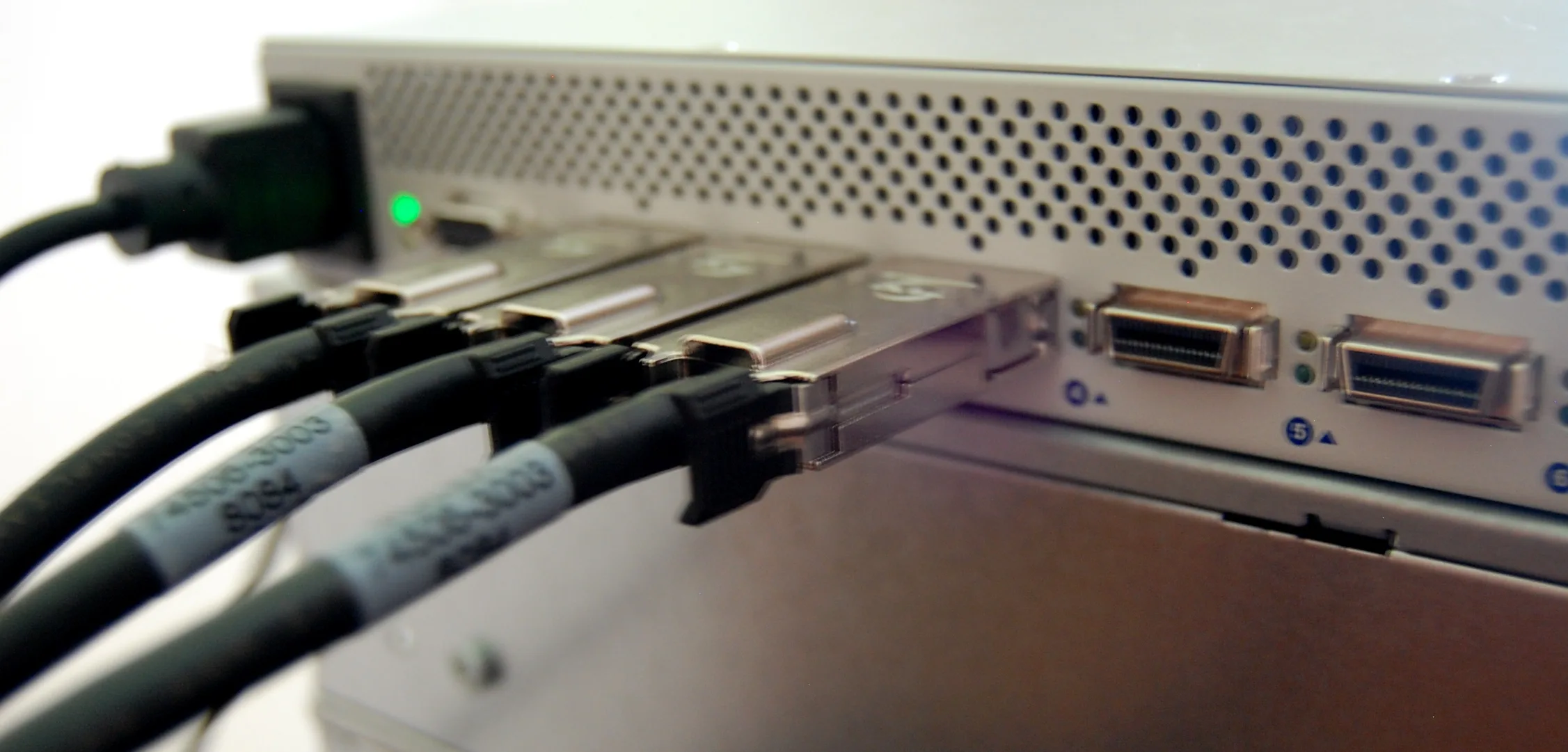
Image: Wikimedia Commons - Infiniband switch & cables.
What Exactly Is Dell Storage NVMe-oF?
NVMe-oF stands for “Non-Volatile Memory Express over Fabrics.” The idea is to carry the NVMe command set not only inside a server over PCIe, but also across an external network or SAN fabric. That means NVMe-oF is not just a disk topic. It is an access-model and fabric-design decision.
In enterprise practice, that means:
- lower-latency goals between host and storage
- more efficient queue behavior
- stronger alignment with modern flash media
But one distinction matters immediately: NVMe-oF is not implemented the same way in every environment. On the Dell side, two transport models matter most:
NVMe/FCNVMe/TCP
This creates two different decision paths: one for organizations with established Fibre Channel investment and another for those building modern Ethernet-based storage fabrics.
How Is NVMe-oF Different from iSCSI or Traditional FC?
NVMe-oF is often described too simplistically as “faster than iSCSI.” A better explanation is that NVMe-oF aims to carry modern flash behavior with lower protocol overhead and better parallelism than older SCSI-heavy access patterns.
Why can it matter?
- the queue model is more efficient
- it can take better advantage of modern CPUs and high-speed Ethernet or FC links
- it may deliver better behavior for latency-sensitive workloads
Does it always improve results automatically?
No. NVMe-oF success depends on:
- correct switch topology
- dedicated storage networking
- sound MTU and buffer design
- correct multipathing on the host
- full platform and software support for the chosen transport
That is why NVMe-oF is not just a protocol swap. It is an end-to-end design choice.
How Is NVMe-oF Positioned on Dell PowerStore and PowerMax?
Dell PowerStore
Dell’s official PowerStore materials explicitly list FC, NVMe/FC, iSCSI, and NVMe/TCP as supported front-end block protocols. The same product positioning also emphasizes all-NVMe and active/active design.
That means:
- NVMe-oF is not a side feature on PowerStore
- it fits the platform’s end-to-end NVMe architecture story
- it gives both FC-oriented and Ethernet-oriented organizations a formal path forward
Dell’s own 100Gb NVMe/TCP messaging also shows that PowerStore is positioned to make Ethernet-based NVMe more practical in modern datacenters.
Dell PowerMax
PowerMax product pages position the platform as enterprise NVMe storage and explicitly reference support for NVMe, NVMe-oF, and traditional SAN protocols. The PowerMax 2500 technical page also describes it as an all-flash, end-to-end NVMe mission-critical storage platform.
That makes NVMe-oF especially relevant on PowerMax for:
- mission-critical production workloads
- high-value low-latency database environments
- consolidated enterprise block-storage designs
So the Dell Storage NVMe-oF topic is not tied to one product family. PowerStore carries it in a modern, broad enterprise design, while PowerMax carries it into higher-end mission-critical environments.
How Should You Decide Between NVMe-TCP and NVMe-FC?
The right question is not “which one is better,” but “which one fits the existing fabric, skills, and operational model better.”
NVMe/FC is often the better fit when:
- the organization already runs Fibre Channel SAN
- the storage team is operationally mature with zoning and FC fabric management
- the goal is to preserve established SAN discipline while modernizing protocol behavior
NVMe/TCP is often the better fit when:
- the organization is building a new Ethernet-based storage network
- FC expansion cost is being reduced
- PowerStore is being deployed with a 100Gb Ethernet-centric architecture
Dell PowerStore official content and support KBs show that NVMe/TCP design still depends on correctly assigned storage network purposes and host alignment. So while NVMe/TCP may look more approachable, it still requires fabric discipline.
What Design Mistakes Happen Most Often?
Treating NVMe-oF as only a protocol swap
The bigger change is architectural: storage, network, host, and operations all shift together.
Forcing FC onto TCP-native teams or TCP onto FC-native teams
Either path may work technically, but the wrong operations model increases delivery risk.
Ignoring the switch and NIC/HBA layer
The protocol may function, but the latency and consistency targets may still fail.
Treating VMware or host integration as a separate decision
In virtualized environments especially, datastore behavior and host support are part of the same design, not a later add-on.
Related Content
- Dell Storage Disk Types and Performance Comparison
- What Is Dell PowerStore Controller Architecture? Guide
- How Does Dell Storage High Availability Work?
Checklist Before Deployment
- the choice between NVMe/FC and NVMe/TCP was aligned with the existing fabric model
- storage traffic was separated from client traffic
- switch, NIC/HBA, and host-driver support were validated
- official Dell platform and software support was confirmed
- multipathing and failover testing were included in the deployment plan
- performance goals were tied to real workload behavior, not only protocol branding
Next Step with Leon-X
Choosing Dell Storage NVMe-oF is not only about adopting a modern protocol. It means designing the datacenter network, storage platform, and host operating model together. Leon-X supports that process under Hardware and Software Services, especially through NAS / SAN Storage Setup and Configuration and Storage Capacity Planning and Performance Optimization. To turn the design into a real project plan, use the Contact page to coordinate the next step.
Frequently Asked Questions
Is NVMe-oF the same thing as NVMe/TCP?
No. NVMe-oF is the broader umbrella term. NVMe/TCP is the TCP-based transport within that umbrella. NVMe/FC is the Fibre Channel transport.
Does Dell PowerStore support NVMe/TCP?
Yes. Dell’s official PowerStore product pages explicitly list NVMe/TCP support for block and vVol connectivity.
Is NVMe/FC always better than NVMe/TCP?
Not automatically. Existing FC investment, team expertise, port economics, and Ethernet design all affect the right answer.
Does PowerMax also support NVMe-oF?
Yes. Dell PowerMax product pages explicitly position the platform with support for NVMe, NVMe-oF, and traditional SAN protocols.
Why is NVMe-oF not only a storage-team decision?
Because switching, host behavior, multipathing, virtualization, and storage all participate in the final result. A single-team-only approach is incomplete.
Sources
- Dell PowerStore All-Flash Storage
- Dell PowerStore 500T Tech Specs
- What’s New in PowerStoreOS 3.6?
- Boost Your Workload Performance with NVMe/TCP
- Dell PowerStore Best Practices Guide
- Dell PowerMax
- PowerMax 2500 Mission-Critical Storage
- Using Dell PowerMax with VMware Cloud Foundation 9.0 - NVMe/TCP
- Wikimedia Commons - Infiniband switch & cables