Dell storage cache problems are often described simply as “the storage became slow,” but in practice the real issue is usually that cache behavior falls back from write-back to write-through, the array enters a protection mode after a controller event, or a cache-safety mechanism disables the expected performance benefit. The short answer is this: when you suspect a Dell storage cache problem, you should first confirm whether the system has fallen into single-controller mode, whether the volume cache policy has switched to write-through, and whether cache backup power, supercapacitor behavior, and cache status LEDs point to a protection event instead of a simple fault.
This guide is especially for:
- Dell storage administrators
- storage and virtualization operations teams
- IT leaders balancing performance against data safety
- technical teams managing PowerVault ME4/ME5 or Dell RAID cache behavior
Quick Summary
- Dell’s ME5 guide states that the system switches to write-through caching when it fails over to a single controller.
- Dell also states that write-through has lower write throughput than write-back, but it is safer from a power-loss perspective.
- Dell’s owner manual explains that cache flush to persistent media typically takes about
60 secondsper1 Gbyteof cache. - Cache Status LED behavior is a major diagnostic clue; for example, a
1:10blink pattern may indicate cache flush or protection mode. - Auto write-through triggers can move the system to write-through if cache backup power is not fully charged or has failed.
Table of Contents
- What Does a Dell Storage Cache Problem Really Mean?
- What Should You Check in the First 10 Minutes?
- Why Does the Write-Back vs. Write-Through Difference Matter?
- How Do Controller Failover and Cache Protection Work?
- What Does the Cache Status LED Tell You?
- What Are the Most Common Mistakes?
- Related Articles
- Checklist
- Next Step with Leon-X
- Frequently Asked Questions
- Sources
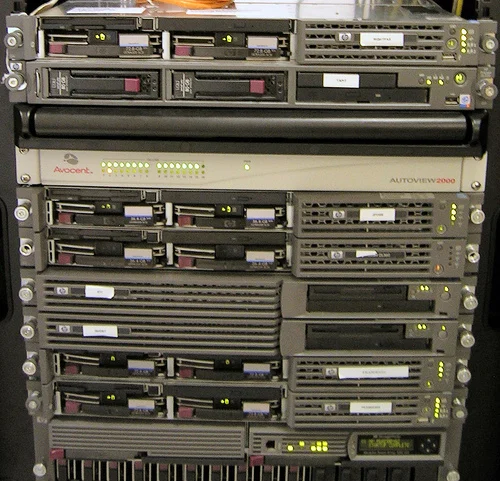
Image: Wikimedia Commons - Computer server rack.
What Does a Dell Storage Cache Problem Really Mean?
This issue is not one alarm type. In the field, it usually appears as:
- a sudden drop in write performance
- lower throughput after controller failover
- warning behavior around the cache status LED
- a volume cache policy unexpectedly moving to write-through
- rising latency at the host side even though the array still appears healthy
The key point is that a cache problem does not always mean data loss has occurred. In many cases, the array is deliberately becoming more conservative in order to reduce data-loss risk, and performance drops as a consequence.
What Should You Check in the First 10 Minutes?
1. Has the array fallen into single-controller mode?
Dell’s ME5 documentation is clear here: the array can run with one controller, but redundancy is lost and the system may switch to write-through mode. So the first question is not performance. It is redundancy state.
2. What is the current volume cache policy?
Is write-back active, is write-through active, or did an automatic trigger force the change? You cannot diagnose the problem correctly without separating those cases.
3. Is there an issue with cache backup power or the supercapacitor?
Dell’s auto write-through documentation makes it clear that the cache mode can change automatically if cache backup power is not fully charged or fails.
4. What is the Cache Status LED showing?
The owner’s manual LED behavior is critical for distinguishing between cache flush, self-refresh, and controller-level fault handling.
Why Does the Write-Back vs. Write-Through Difference Matter?
To understand the operational impact of a cache problem, you need to understand these two modes clearly.
Write-back
In write-back mode, data is acknowledged after entering cache and then written to disk. This delivers higher write performance. But it also means cache protection mechanisms matter during controller or power events.
Write-through
In write-through mode, the controller does not acknowledge the write until the data is actually written to disk. Dell explicitly states that this mode provides lower throughput than write-back, but it is safer.
So if the system falls back to write-through, that is not always a hardware failure. It is often a controlled protection behavior. The tradeoff is performance.
How Do Controller Failover and Cache Protection Work?
Dell’s ME5 guidance on failover to a single controller provides the core operational logic:
- the system can continue with a single controller
- but redundancy is no longer present
- in that state, the system moves to write-through caching
The reason is straightforward. If write-back is active, unwritten data may still exist in cache. If the remaining controller also fails, that unwritten data may be at risk.
Dell’s owner manual adds a useful hardware-level detail:
- writing cache to persistent media typically takes around
60 secondsfor every1 Gbyte - only the components needed for the cache write are powered by the supercapacitor during that phase
- LED behavior changes while the array preserves or flushes the cache
This is why “just reboot it” is not a disciplined response. You first need to know whether the system is protecting or flushing cache.
What Does the Cache Status LED Tell You?
Dell’s owner manual maps LED behavior directly to troubleshooting actions. The most operationally relevant cases include:
- LED off while the controller does not boot may indicate a controller module problem
- LED off while the controller boots can indicate data has already been flushed to disk
- a
1:10blink while the controller does not boot can point to a module replacement path - a
1:10blink while the controller boots can indicate that cache is being written out - a
1:1blink at2 Hzor1 Hzcan indicate self-refresh or related protection behavior
The operational lesson is simple: LED behavior helps prevent you from confusing a protection event with a pure hardware failure.
What Are the Most Common Mistakes?
Treating a write-through fallback as an outright failure
It is often a deliberate protection response. The real task is to understand what triggered it.
Leaving the system in single-controller mode for too long
The array may still operate, but the redundancy model has already been degraded.
Ignoring backup power or supercapacitor health
This is one of the most important trigger areas for cache policy changes.
Looking only at the array and not at the host impact
If the storage falls into write-through, host latency and application behavior often change as well. That is why Hardware & Software Services should be used to review both storage and host behavior together.
Treating every cache problem like a disk problem
The real root cause may be controller redundancy, cache policy, or the cache protection layer rather than the media layer itself.
Related Articles
- How Does Dell Storage High Availability Work? Guide
- Dell Storage Multipath Not Working
- What Is Dell Storage NVMe-oF? Guide
- Dell PowerStore High Latency Problem
Checklist
- confirm whether the system has dropped into single-controller mode
- review whether the volume cache policy is write-back or write-through
- check cache backup power or supercapacitor state
- compare cache LED behavior against the owner’s manual
- review host latency and application impact alongside array state
- if needed, plan a safe shutdown or data protection step before escalation
Next Step with Leon-X
A Dell storage cache problem is not only a performance topic. It is also about data safety, redundancy, and operational storage standards. Leon-X combines Hardware & Software Services, especially Storage Capacity Planning and Performance Optimization and NAS / SAN Storage Installation and Configuration, to review cache behavior as an architectural issue instead of a single alert. For assessment, planning, or a proposal, continue through the Contact page.
Frequently Asked Questions
How do Dell storage cache problems usually show up first?
Most commonly through performance drops, write-through fallback, controller failover side effects, or cache status LED warnings.
Does switching to write-through mean data loss has already happened?
No. In many cases it means the array is trying to reduce data-loss risk.
If the system is still running with one controller, is the situation acceptable?
It may still operate, but redundancy has already been lost and the risk profile is higher.
Why is the Cache Status LED so important?
Because it helps distinguish between active cache flush, self-refresh behavior, and controller fault scenarios.
Sources
- Dell PowerVault ME5 Series Administrator's Guide - Data protection during failover to a single controller
- Dell PowerVault ME5 Series Administrator's Guide - Using write-back or write-through caching
- Dell PowerVault ME4/ME5 Owner's Manual - Controller failure when a single controller is operational
- Dell PowerVault ME4/ME5 Administrator's Guide - Change auto write-through cache triggers and behaviors
- Dell Server Administrator Storage Management - Read, write, cache, and disk cache policy supported by PERC hardware controllers
- Wikimedia Commons - Computer server rack